
 |
 |

 |
 |

 |
 |

 |
 |

 |
 |

 |
 |
@
Réfer. : 2012 .
Auteur : Newman William R.
Titre : Gehennical Fire.
S/titre : The lives of G. Starkey.
Editeur : Harvard Univ. Press.
Date éd. : 1994 .
@
Note au lecteur :
=================
Un ensemble de gravures (mises en onglet), situées entre la page 164 et 165, ont été déportées à la fin du document, afin de pouvoir
respecter la pagination dans la base de données.
Le traducteur.
@
**** A T T E N T I O N ****
Ce document étant sujet à droits d'auteur, n'est composé que du début, et des tables éven-
tuelles. Reportez-vous aux références ci-dessus
pour vous le procurer.
**** A T T E N T I O N ****
Gehennical Fire
"This is the true Ignis Gehennae, for it Eclipseth the
light of the Bodies, and makes them become black as
Pitch; which is a symbol of Hell, and for its Cimmerian
darkness is by many of the Wisemen called Hell."
--George Starkey, Ripley Reviv'd
@
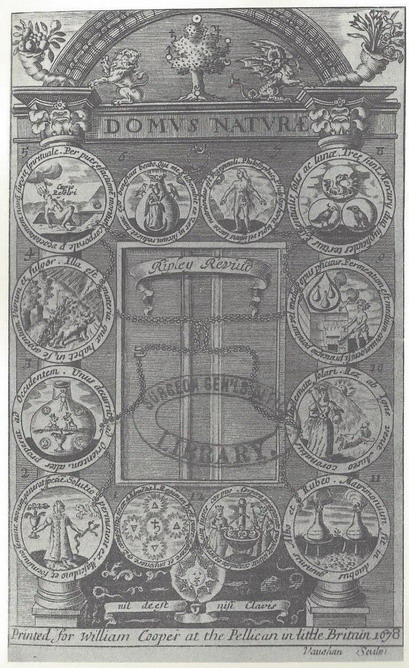
Figure 1. The locked door of the alchemical secret, surrounded by traditional sayings (dicta) relating to the alchemical magnum opus. From Eirenaeus Philalethes' collected
commentary on the fifteenth-century Georges Ripley, Ripley Revivi'd (London, 1678).
@
G e h e n n i c a l F i r e The Lives of George Starkey, an American Alchemist in the Scientific Revolution
WILLIAM R. NEWMAN
Harvard University Press Cambridge, Massachusetts London, England 1994
@
Copyright © 1994 by the President and Fellows of Harvard College
All rights reserved
Printed in the United States of America
This book is printed on acid-free paper, and its binding materials
have been chosen for strength and durability.
LIBRARY OF CONGRESS CATALOGING-IN-PUBLICATION DATA
Newman, William R.
Gehennical fire : the lives of George Starkey, an American alchemist in the scientific revolution / William R. Newman. p. cm. Includes bibliographical references and index. ISBN 0-674-34171-6 (acid-free) 1. Starkey, George, 1627-1665. 2. Alchemists--England--Biography. 3. Alchemy--History. 4. Science--England--History--17th century.
I. Title.
QD24.S73N49 1994
540'.1'12'092--dc20 94-9508
[B] CIP
@
To Marleen, Emily, and Ben
@
@
Contents
Acknowledgments ix A Note on Terminology xi
Introduction 1 1 Starkey in America 14
2 Arcana Maiora: The Hartlib Years (1650-1654) 54
3 The Background to Starkey's Chymistry 92
4 Revelation and Concealment: The Writings of Philalethes 115
5 A Sonne of Contention: 1655-1665 170
6 Philalethes in Context 209
7 Isaac Newton and Eirenaeus Philalethes 228
Appendix I Starkey's Addresses in England, 1650-1665 247
Appendix II An Autobiographical Note by George Starkey 248
Appendix III Missing Starkey Manuscripts 252
Appendix IV Robert Boyle's "Excuses of Philaletha" 254
Appendix V A Bibliography of Starkey's Writings 256
Abbreviations 275 Notes 277 Index 339
@
Illustrations
1 Frontispiece of Ripley Reviv'd ii
Following page 164: 2 The star regulus of antimony 3 (A-G) Illustrations from the Opera omnia of Philalethes 4 Frontispiece of Pyrotechnia ofte Vuur-stuck-Kunde 5 The tomb of Lionel Lockyer 6 An advertisement for Lockyer's Pill 7 Excerpt from Newton's 1678/9 letter to Boyle 8 Frontispiece of Nathan Lacy's De podagra
@
Acknowledgments
First thanks go to I. Bernard Cohen, who suggested that I submit a book on
George Starkey to Harvard University Press and who encouraged its production
in many ways. But the initial project predates my professional
involvement with the History of Science. As an undergraduate, I was
fortunate enough to work with three outstanding scholars in the fields of
literature and science--Harold Jantz, who wrote on Philalethes (Starkey's
alias in alchemical literature), Elizabeth Sewell, and O. T. Benfey--all of
whom tolerated my youthful enthusiasm for the subject. The "American
philosopher," as Starkey's contemporaries referred to his persona, has intrigued
me ever since.
My fascination with this subject stems also from the beautiful treatment of Starkey given by George Lyman Kittredge in a seminal article written
three-quarters of a century ago. Kittredge's unpublished notes, resident in
the Harvard University Archives, have proven to be an almost inexhaustible
source of Starkeiana.
I also owe thanks to more immediate sources, in particular to Lawrence Principe, who offered a number of important alterations to my understanding
of Starkey's chemistry. Chapters 4 and 5 owe a particular debt to Principe's
knowledge and goodwill. Monika Asztalos, Martha Baldwin, Peter Buck,
Harold J. Cook, Lorraine Daston, Mordechai Feingold, Karin Figala, Peter
Galison, Owen Gingerich, Rupert Hall, Robert Halleux, Michael Hunter, John
Murdoch, P. B. Newman, Katherine Pack, A. I. Sabra, Steven Shapin, Alan
Shapiro, Pamela Smith, Abha Sur, Richard Westfall, and Walter Woodward
all read part or all of the book and provided valuable comments.
ix
@
x º Acknowledgments
Others whose contributions helped me include Ulrich Neumann, who located essential German documents; John Young, who helped retrieve
valuable material from the Hartlib papers in Sheffield, and Annabel Gregory,
who expanded the shorthand of Starkey's fragmentary diary. I also acknowledge
the help of Susanna Âkerman, Ann Blair, Allan Brandt, Gerald
Beasley, Theresa Bridgeman, Antonio Clericuzio, Anthony Grafton, Anita
Guerrini, Steven Harris, Miles Jackson, Lynn Joy, Richard Kennedy, Tzvi
Langermann, Dorothy Porter, P M. Rattansi, Timothy Raylor, Sandra Rouja,
Thomas Siegel, and John Symons, from whose advice I benefited in a variety
of ways.
Among the libraries and archives to whom special thanks are owed I must include the Harvard University Archives, Houghton Library, the British
Library, the library of the Royal Society, the Bermuda Archives, the library of
the University of Glasgow, the Wellcome Institute, and the Massachusetts
Historical Society.
The research and writing of this book were underwritten by the following grant-giving organizations (in chronological order): the Warburg Institute,
the American Philosophical Society, the National Science Foundation
(Grant DIR-8808685), Stonehill College, Harvard University, and the Dibner
Institute.
@
A Note on Terminology
The reader of this book may at first be perplexed by my use of the terms
alchemy and chemistry and the now archaic chymistry. But there is good
reason to retain all three words. The Latin terms chymia and alchymia
(alternatively chemia and alchemia), from whence we get our modern
names, were rigorously synonymous until the seventeenth century, as
Robert Halleux, a profound historian of this subject, has asserted. (1) Only
during the Enlightenment were they severed once and for all, as when the
French chemist E. E Geoffroy wrote his blistering Supercheries concernant la
pierre philosophale of 1722. (2)
The two terms were still widely interchangeable throughout the seventeenth century. This presents problems to the modern reader, for most of us
think we already know what alchemy meant--the transmutation of base
metals into gold. Chemistry, too, will have a well-defined sense to most
modern readers, and one that has little to do with metallic transmutation.
The reader may find it an abrupt shock, then, to consider the definition that
George Starkey, the subject of this book, gives to alchemy. He derives the
term from a fusion of the two Greek words hals, or "salt," and chëmeia,
which he took to mean "separation," for to Starkey, alchemy "is the Art of
separating Salts." (3) There is nothing about either transmutation or even gold
in Starkey's definition, though these subjects were seldom far from his
thoughts, and if alchemy means the separation of salts, then chemistry to
hint matis "separation" proper.
Starkey's definition is idiosyncratic, but indicative of the interpretive difficulties that arise when we encounter the words of another era. I ask the
xi
.............................................................................
@
@
Introduction
Why should anyone choose to write a book about George Starkey? To judge
by the work of contemporary historians, he was an obscure figure indeed.
Despite his having been a colonial American scientist, Starkey receives no
entry at all in the Biographical Dictionary of American Science, which purports
to cover the seventeenth through the nineteenth centuries, nor is he
found in the Dictionary of American Biography. (1) While R. P. Stearns's
authoritative Science in the British Colonies of America does mention Starkey,
it limits his representation to four lines out of seven-hundred-odd pages. (2)
As Stearns notes, Starkey was a native of Bermuda who received his A.B.
from Harvard College in 1646. He immigrated to London in 1650 and
became a prominent physician there, only to die in the great plague of 1665.
During these years in England Starkey wrote several influential medical
works that continued to arouse interest into the eighteenth century. But
this is only a small part of his extraordinary story, for Stearns and other
historians of American science have failed to realize that Starkey in fact led
two lives.
Thanks to the researches of George Lyman Kittredge at the beginning of this century, and to later work by Harold Jantz and R. S. Wilkinson, it has
long been suspected that Starkey secretly penned a number of influential
works on alchemy, printed under the name of Eirenaeus Philalethes--literally,
"A Peaceful Lover of Truth." (3) What had hitherto seemed probable is
now a matter of fact, for an analysis of Starkey's letters has recently allowed
me to prove that Starkey and Eirenaeus Philalethes were indeed one. (4)
But Eirenaeus Philalethes was more than a mere pseuclonyin, at least in the usual sense. Not content merely to adopt the name or Philalethes,
1
@
2 º Gehennical Fire
Starkey went so far as to spread elaborate stories of his alter ego, claiming
that Philalethes was a friend of his, still living in New England, whose name
Starkey was under oath not to reveal. The secretive Philalethes went by the
cognomen philosophus Americanus, but his identity remained unknown
even to Starkey's closest friends. (5) This "American philosopher" was reputed
to have performed miraculous feats in New England, such as restoring the
hair and teeth of an aged lady and bringing a withered peach tree to produce
new fruit. (6) Most important of all, however, Starkey broadcast the rumor
that Philalethes was an adept--a possessor of the alchemical philosophers'
stone, the agent of metallic transmutation. In this way Starkey managed to
create a mythological persona of such charisma that long after his creator's
death many believed him still to be alive and performing transmutations in
the "English Islands or Plantations" in America. (7)
The works written by Starkey under the pseudonymous epithet of Eirenaeus Philalethes were spectacularly successful. His most popular
work, the Introitus apertus ad occlusum regis palatium (An open entrante to
the closed palace of the king), went through at least nine Latin editions, not
to mention its many translations into vernacular languages. (8) Collected into
Philalethes' Opera omnia (Complete works) in 1695, the Introitus was
reprinted as late as 1749. (9) Philalethes' works were known to G. W. Leibniz,
(10) commented by Robert Boyle, (11) and esteemed by Isaac Newton. Indeed,
on the basis of the latter's attentions, Philalethes has been called by
one Newton scholar "the last great philosophical alchemist." (12) It is highly
likely that Starkey's output under the guise of Philalethes makes him the
most widely read American scientist before Benjamin Franklin. (13)
How can it be that a man of Starkey's humble origins and provincial background achieved such success? Clearly the answer to this question
cannot be had without a serious revision both of contemporary views about
the role of alchemy in the scientific revolution and about the provinciality
of colonial American science. In the present work we can only make a first
step toward those goals, but without laying the foundations we shall
achieve nothing. Let us therefore proceed into the world of rumor and
intrigue that surrounded successful alchemists of the early modem period.
A foray into the realm of alchemy will demonstrate the degree to which the philosophers' stone had become the idée fixe of the age. Here the reader
will meet Eirenaeus Philalethes in his own environment, a literary world of
anonymous adepts and their desperate followers, the roiling masses in,
quest of the philosophers' stone. A stark contrast exists between this glittering
and artificial world and that of Starkey's upbringing, the barely hewn
wilderness of Bermuda and New England, discussed in Chapter 1. It is only
@
Gehennical Fire º 3
fitting that the reader first encounter the fabulous Philalethes in his chosen
milieu, in the company of the great adepts of the seventeenth century.
Elias Artista, Alexander Seton, and the Transmutation History
Between 1652 and 1658 the radical Fifth Monarchist Mary Rand predicted
that "the philosophers stone" would become "speedily vulgar" in the coming
reign of Christ on earth. (14) It was thus that an idea born of late Hellenism
and elaborated in the shadowy enclaves of Ismaili alchemy came to be
appropriated by the millenarians of seventeenth-century England. (15) But this
reference to the promise of alchemical riches was not an isolated instance.
Although alchemy had been a relatively marginal discipline in the occidental
Middle Ages, it exploded into the mainstream of early modem Europe
with a catastrophic violence. (16) The philosophers' stone, an agent of transmutation
promising to "perfect" ten times, one hundred times, even a
thousand times its own weight of base metal, became the cause célèbre of the
age of gold. (17)
But the medieval sages who had discovered this marvelous instrument of God's beneficence had also learned of His stinginess in bestowing it. Indeed,
the thirteenth-century Summa perfectionis of pseudo-Geber asserts that the
philosophers' stone is a donum dei--a gift of God--which He "extends to
and withdraws from whom He wishes." (18) Suddenly, in the seventeenth
century, it seemed that the Father of Lights was about to raise His veil of
mystery and illumine not only his chosen, the "sons of wisdom," but even
the enthusiastic followers of Mary Rand.
How is it that alchemy acquired its association with prophecy? There are strong medieval precedents for the connection, but for us the story begins
with Paracelsus von Hohenheim (1493-1541), an iconoclastic Swiss physician
who is famous for fusing the techniques of alchemy with the aims of
medicine to arrive at the discipline of chemiatria--medical chemistry or, as
it is usually called, iatrochemistry. (19) Paracelsus had predicted that sometime
after his death "Helias" or "Elias the Artist" would come and reveal the
hidden secrets of nature. This "Elias" was of course the prophet Elijah,
whose second coming had already been predicted by the Bible. The
prophetical tradition of medieval Europe had made Elias a cornerstone of its
predictions: hence the twelfth-century prophet Joachim of Fiore had longed
for his arrival as the opening to an age of renovatio. (20) But to Paracelsus, Elias
was more than a prophet--he was a magus and alchemist who would
perform miracles of transmutation. (21) In his work Von den natürlichen Dingen,
Paracelsus says the following:
..................................................................................
º 1 º
Starkey in America
We have seen that in his later life the fabulous adept Eirenaeus Philalethes,
claiming to have discovered the philosophers' stone at age twenty-three,
portrayed himself as a precursor of the reformatory Paracelsian Elias. But
behind the elegant Latin and prophetic zeal of the Philalethes tracts,
wrapped in the folds of mannered obscurity, a human face can be discerned.
The author of the Introitus apertus ad occlusum regis palatium
was--and of this there may be no doubt--George Starkey. (1) The remarkable
dispersion of the Philalethan corpus will concern us later: it is our
business now to disinter the neglected remains of Starkey. Surprising
riches will be found inhumed along with him. In particular, we must
resurrect the early Harvard physics curriculum, which in Starkey's day,
contrary to a common view, was in a surprisingly lively and energetic
state.
Physics at Starkey's Harvard was not a mere recitation of classical authors; rather, it was intended to incorporate the major innovations of
the day. Nor was Harvard immune to the charms of alchemy, for we shall
find that Starkey was initiated into that art as an undergraduate. Indeed,
as I. B. Cohen argued many years ago, Harvard and New England were
most congenial to chymistry. (2) In this chapter I shall argue that Starkey's
subsequent success in Europe must be viewed in the light of his excellent
preparation in the colonies. But the unique degree of Starkey's
influence impels us to consider his life as a whole, for even after the
mask of Philalethes has been stripped away, there is much that is en igmatic.
14
@
Starkey in America º 15
Childhood Years in Bermuda
Of George Starkey's early life, Little is known. Born George Stirk, he changed
his surname to Starkey in or before 1650. (3) We shall refer to him henceforth
as Starkey. Even his birthdate is contested--while his astrological nativity
gives the date and hour of his birth as June 9, 1628, 11:35 A.M., a surviving
autobiographical note states that he was born on June 8. (4)
Despite this confusion, we do know something about his family. Starkey had at least three sisters and a brother--Elizabeth or Sibill, Mary, Agnes,
and Samuel. (5) Their father, George Stirk the elder (c. 1595-1637), was a
Scottish minister who immigrated to Bermuda in November 1622, with
Governor John Bernard. Although a high Calvinist by inclination, Stirk was
employed in the attempt to return Bermuda to the orthodox practice of the
Church of England. For this he eventually received the annual sum of £40,
although his payment was often in arrears. (6)
Although nothing is known of the elder Stirk's education, we may conclude that he was not unlearned. He published a volume of Latin elegiac
poetry entitled Musae Somerenses in 1635. The preface, written to the
Bermuda Company, reveals that Stirk intended his Musae as a "sacred
history" to be used in a yet-to-be established school. "In this final period of
the aging world," Stirk says, "the Lord has revealed a New World, no
smaller than the Old." The reason for this revelation is not for the furtherance
of profit, nor to provide a dwelling-place for colonists. Rather, God
wished that the "barbarians" be converted and the kingdom of Christ
spread. Hence the importance of a school in the Somers Islands--that is,
Bermuda. Unlike mainland America, the Somers Islands lack a horde of
enemies who might disrupt this important work. (7) Since Bermuda is devoid
of indigenous Indians, Stirk argues, it would be the perfect place to transplant
those native Americans worthy of a Christian education. Unable to
worship or engage in commerce with their brethren, or flee, they would
surely accept the proper word of God.
Stirk intended his Musae Somerenses as a Latin primer to be used in the proposed school: as he says, alongside "our children," the "Americans"
would learn from it their Latin and sacred history. Such schemes for educating
and converting Indians would receive considerable attention in the
1650s when Harvard College established its own "Indian College." (8) As it
happens, however, Stirk never fulfilled his messianic hopes. In 1637 he died
of an unspecified but chronic illness, leaving his wife, daughters, and two
sons.
...........................................................................
º 2 º
Arcana Maiora:
The Hartlib Years (1650-1654)
In the foregoing chapter, we left Starkey in the provincial town of
Boston, embarking for London in the fall of 1650. It is almost unbelievable
that in a matter of months we shall find him giving detailed alchemical
advice to one of the most famous chemists of the modem period--
Robert Boyle. Nor was this counsel unsolicited. Boyle eagerly sought out
the knowledge of Starkey in matters of the chemical philosophy, subsidized
Starkey's experiments, and submitted his own relatives to Starkey
for chemical cures. It appears that the combination of an active experimental
circle in New England and his own native ingenuity made it
possible for Starkey to acquire immediate acclaim in England as an
alchemical savant.
The frenzied activity of Starkey's first four years in England makes it necessary to divide this period into several narratives. Since the focus of this
chapter will be Starkey's relationship to the informal scientific society
gathered around Samuel Hartlib, we shall begin with Hartlib himself, and
his interest in chemistry. The origin of Starkey's fictive adept, Eirenaeus
Philalethes, can only be understood as a response to currents within the
Hartlib circle. The Philalethes tracts betray a complex attitude toward
secrecy and the revelation of knowledge, which is best approached in turn
by considering Starkey's close association with Robert Boyle. This will form
our third narrative. Finally, Starkey's diverse activities while a member of
the Hartlib group will give us occasion to look at a broader issue--the
all-encompassing promise of alchemy or "chymistry" to the seventeenth-
century mind.
54
@
Arcana Maiora º 55
Samuel Hartlib, a German émigré who studied at the University of Cambridge
in the 1620s and settled in England, is too well known to require a
comprehensive introduction. (1) Modeling himself on the French promoter of
intellectual communication Théophraste Renaudot, Hartlib masterminded
an English agency for the same end. Called the "Office of Address," Hartlib's
agency sought state funding in order to implement the applied science of
Francis Bacon and the pedagogical agenda of the Czech reformer Jan Amos
Comenius. Thus Hartlib combined the ideas of "lucriferous" knowledge--
productive natural philosophy--and pansophia, the Comenian ideal of universal
learning. Indeed, Hartlib's group already had some points in common
with the Royal Society, although he died too soon to play an active part in
the group that fostered Newton, Halley, and Hooke. (2) To Hartlib's emphasis
on utility was added a heady dose of millennial utopianism, already present
in Bacon and Comenius but abetted by the influence of Johann Valentine
Andreae. (3) Andreae, who drafted the blueprint for an ideal Christian
state in the form of his Christianopolis, was also the self-professed author
of the Chymical Wedding of Christian Rosenkreutz, a baroque alchemical
conceit in which chemical reagents and processes become the characters of
a romance. (4) We should not be surprised, therefore, that alchemy came to
occupy a central position in the concerns of Hartlib and his friends.
Hartlib was a publicizer of applied science in many areas--agriculture, economics, and even the technology of warfare were all immediate
objects of his purview. (5) He also promoted alchemists and iatrochemists,
although there is Little evidence that he performed experiments himself. (6)
One of Hartlib's associates and protégés was Gabriel Plattes, an inventor
and alchemist whose Macaria, a Baconian utopia, was published in 1641.
Although written in the form of a utopia, it is clear from remarks made
by both Plattes and Hartlib that Macaria was the blueprint for a real--if
never realized--society. Alchemy is a major focus of Macaria, for in it
Plattes describes a "Colledge of experience" containing an alchemical
laboratory. (7) Plattes's desire for a well-funded alchemical laboratory is
repeated in his "Caveat for alchymists," published in the Chymical, Medicinal
and Chyrurgical Addresses: Made to Samuel Hartlib Esquire (1655).
Plattes's request for a laboratory, which he made to Parliament, typifies
his and Hartlib's view that alchemy, like agriculture and medicine, could
he put to the public good. He wished to be of service "in three things
principally":
@
56 º Gehennical Fire
to wit, to shew how the husbandry of this Land may be so improved, that it may maintain double the number of people, which it now doth, and in much more plenty: also to shew how the Art of Physick may be improved: and lastly to shew the Art of the transmutation of Mettals, if I may have a Laboratory, like to that in the City of Venice, where they are sure of secrecy, by reason that no man is suffered to enter in, unless he can be contented to remain there, being surely provided for, till he be brought forth to go to the Church to be buried. (8)
Despite the frequent appeals to openness of communication made by Hartlib and his friends, in Plattes we encounter once again the alchemical
secrecy of a Jonathan Brewster or John Allin. Hartlib, like Plattes, was
deeply interested in every aspect of alchemy. Overjoyed when his daughter
married the alchemist and Helmontian physician Frederick Clodius in the
early 1650s, Hartlib allowed the kitchen of his bouse to be converted into a
laboratory. (9) But, again like Plattes, he insisted on secrecy in alchemical
affairs. In a 1659 letter to Boyle he relates that
Dr. Jones's work is going on again and he is filled afresh with very great expectations. His secret friend tells him, if the account of the particular operations, which he hath given him from time to time, be true, it will certainly yield both the universal medicine and the tincture: if it should fail, I am assured from others, that Macaria is a real possessor of both these great blessings, but will own neither of them professedly. But this only amongst ourselves.' (10)
Once again we are back in the realm of secretive adepts stingily imparting their wisdom: in this case, the recipient is one Dr. Jones, presumably Bassett
Jones, a physician held in high esteem by Hartlib. (11) Hartlib is hopeful that
Jones is about to acquire "the universal medicine and the tincture," that is,
the philosophers' stone in its dual roles as panacea and agent of "chrysopoeia"
(production of gold). What is doubly interesting about this letter to
Boyle is Hartlib's assertion that Macaria too possesses the philosophers'
stone, albeit secretly. It is clear from a letter to John Winthrop written in
1660 that Hartlib believed Planes' ideal society had actually been realized,
and that it was about to become "not onely a true possessor, but a reall
dispenser of these Mysteries." (12) In the same letter, Hartlib says that these
adepts are "minded in England," though still "scattered over the world."
Thanks to the present political upheaval, they remain "most secret and
hidden." Quoting the prophetical writer Guillaume Postel, Hartlib concludes
that "the reformation will begin with the islands," as soon as the
Macarians choose Io make theinselves visible.
**** A T T E N T I O N ****
Fin du texte de ce document, ce document étant sujet à droits d'auteur.
**** A T T E N T I O N ****
@
@
Index
| Abraham the Jew, 116 | Apparatus, laboratory, 40, 47, 52, 53, 81, |
| Acid, 166, 184, 186, 231-234, 237; acetic, | 132, 134, 145, 215 |
| 183, 186, 187; hydrochloric, 183, 186; | Aqua fortis, 139, 140 |
| nitric, 90, 183, 186, 187, 231; sulfuric, | Aqua regia, 152, 158, 231, 237. See also |
| 183, 186, 187, 192 | Assaying |
| Acuation of mercury, 138 | Aqua vitae, 73, 81, 90 |
| Adamic earth, 89 | Aquinas, Thomas, 38, 142 |
| Adepts, 2-14, 41, 44, 45, 56, 67, 75-78, | Arcana maiora, 63 |
| 117, 178; New England adept, 58-62, 75 | Archeus, 150, 166, 175, 176, 204, 205, 217 |
| Agrippa, Heinrich Cornelius, 213-218, | Aries, 128 |
| 220, 221 | Aristotelianism, 21-32, 37, 155-158; form |
| Albertus Magnus, 38, 96, 215 | and matter, 21-32, 92, 98, 158; |
| Alchahest, 57, 63, 65, 72, 83, 91, 146-148, | impossibility of vacuum in nature, 21, 23, |
| 174, 176, 181-188, 242; action of, | 24, 31, 102, 105, 111; impossibility of |
| without reaction, 147, 148, 186, 187; | two bodies in same place, 23, 24, 27, 31, |
| subtlety of, 147, 148 | 167; permanence of matter 23, 24; |
| Alcocke, George, 49 | Aristotle's Physics, 24, 98, 142; continuity |
| Alcocke, John, 48-50, 53 | of matter, 24; every moved body must be |
| Alkalies, 184. See also Volatile alkali | in contact with its mover, 24; Aristotle's |
| Allin, John, 18, 46-48, 56, 63 | De caelo, 25; gravity and levity, 25, 26, |
| Alsted, Johann Heinrich, 38 | 29, 158; Aristotle's De generatione et |
| Ames, William, 37 | corruptione, 28, 153; Aristotle's Meteors, |
| Ammonia, 182, 184, 187 | 98; impossibility of regress from |
| Ammonium: acetate, 183, 185-187; | privation to habitus, 152; potency and |
| carbonate, 172, 182-188; nitrate, 183, | act, 95, 101, 114, 151; transmutation of |
| 185; sulfate, 183, 185; chloride, see Sal | elements, 111, 153, 214 |
| ammoniac | Arsenic, 127, 130, 131, 165 |
| Andreae, Johann Valentine, 55 | Artephius, 135 |
| Andrewes, Ambrose, 193, 194 | Assaying, 9, 90, 131, 140. See also Metallurgy |
| Antichrist, 11 | Astell, Jeremiah, 182, 200, 242 |
| Antimony, 40, 49, 59, 67-69, 74, 76, 80, | Astrology, 221 |
| 127-140, 165, 168, 172-174, 177, 197, | Atherton, Humphrey, 40 |
| 198, 213, 225, 230, 235, 236; extraction | Atoms, 113, 122, 141-144, 146-148, 154, |
| of metals from, 80, 139; regulus of, | 156, 166, 181, 204 |
| 136-139, 172, 180, 198, 231; star regulus | Aureity, 152 |
| of, 129, 130, 133, 135, 165, 225, 230, 236 | Avery, William, 52 |
| Apothecaries, 189 | Avicenna, 33 |
@
340 º Index
| Bacon, Francis, 54, 85, 93 | Cain, 9 |
| Bacon, Roger, 25, 42 | Cambridge, University of, 22, 28 |
| Barkeley, William, 40, 41, 50, 51 | Cardano, Girolamo, 31, 157 |
| Bartlett, William. See Barkeley | Cardilucius, Johann Hiskias, 61, 62, 82, |
| Basilius Valentinus, 127 | 199, 207 |
| Bathurst, Dr., 188 | Cary, Mr., 174 |
| Beale, John, 57 | Celestial influx, 17 |
| Becher, Johann Joachim, 240 | Center and circumference, 94, 101, 103, |
| Bees, 16, 73, 81, 87, 90 | 106,110,114,129, 149,163-165, 168, |
| Beeswax, 18, 90, 91 | 169,178,185,214-216,219, 234-236 |
| Bermuda, 15-18, 40, 41, 80, 83, 191 | Central point of sperma. See Spark of light |
| Bernard of Trier, 93, 99, 103-106, 118, 135, | in matter |
| 151, 157-161,164-166, 180, 221, 224, 226 | Central sun, 87, 88 |
| Bernard, John, 15 | Chaos, 126-130, 133, 136, 223, 234-236 |
| Biggs, Noah, 49, 58 | Charles II, 190, 191, 197, 201, 202 |
| Binarius, 218-221 | Chauncy, Charles, 44, 46 |
| Biographical Dictionary of American Science, 1 | Chauncy, Elnathan, 45, 46, 222
|
| Bird, Mr., 174 | Chemiatria, 3 |
| Bismuth, 127 | Child, Robert, 41-42, 51, 57, 58, 79, 81, |
| Blas, 113, 156 | 190, 191, 222 |
| Blinman, Richard, 52 | Chiratin, 81 |
| Boerhaave, Hermann, 242 | Christian Rosenkreutz, 12, 55 |
| Bond of love. See Species | Christianae societatis pactum, 63, 64, 79 |
| Borel, Pierre, 6 | Chrysopoetic tincture. See Philosophers' |
| Borrichius, Olaus, 210, 241 | stone |
| Bow-Dye, 85 | Chymistry: defined, 84, 85; sources of, |
| Boyle, Robert, 2, 20, 43, 52-54, 58, 62-65, | 92-114 |
| 67-70, 72, 75-80, 82, 83, 93, 128, 140, | Clark, John, 37 |
| 159, 165, 166, 170-173, 178-180, 186, | Claveus, Gasto, 226 |
| 187, 193-195, 209, 222, 224, 229, 231, | Clinical trial, 188, 189 |
| 232, 241, 242; fraternity of, 75 | Clodius, Frederick, 55, 59, 60, 63, 76, 82, |
| Brechtelius, 9 | 83, 173 |
| Brechtelt. See Brechtelius | Close-packing of corpuscles, 97, 102, 105, |
| Brewster, Jonathan, 42-44, 52, 55, 63, 64, | 106, 140, 147-149, 163; prevents entry of |
| 116, 126 | corrosives, 149 |
| Brewster, William, 42 | Cochineal, 74, 80 |
| Bristol, 173, 174 | Codex Speciale, 86 |
| Brock, John, 48 | Cohausen, Johann Heinrich, 240, 241 |
| Browne, Richard, 191 | Cohen, I. B., 14 |
| Buckingham, George Villiers, 2nd Duke of, | College of Physicians, 189, 201-203, 206, |
| 201, 202 | 207 |
| Bulkeley, Gershom, 44-46, 52 | Comenius, Jan Amos, 54 |
| Bulkley, John, 46 | Confinement, 190, 207 |
| Burnet, Thomas, 234-236 | Consanguinity. See Species |
| Butler, 83 | Cook, Harold J., 202 |
| Butterfield, Herbert, 93 | Cooper, William, 60, 61 |
| Copeland, Patrick, 18, 19, 51 | |
| Cabala, 116 | Copernicus, Nicolaus, 34, 36 |
| Cadmus, 130-132 | Copper, 71, 134, 230 ; mercury of, 138., 139 |
Index º 341
| Cork, Elizabeth Clifford, Countess of, 75 | Dung, 89 |
| Corpuscular philosophy, 21-32, 53, 92, 95, | Dunster, Henry, 19, 20, 48 |
| 97-99, 102, 104-106, 141, 154, 231-240; | Dury, John, 59, 63, 78-80, 82 |
| corrosive sublimate, 97 | Dussauce, H., 179 |
| Cosmopolite, 6, 7, 12, 13, 60, 77, 114, 144, | Dyes, 73, 74, 80, 81, 85-87 |
| 208, 240, 241, 242 | |
| Counterfeiting, 63, 200 | Eamon, William, 84 |
| Crasis, 175, 176 | Earth as metallic impurity, 97, 104-106 |
| Crystal formations, 166, 177, 179, 212 | Egyptian gods, 235 |
| Culpepper, Cheney, 80 | Elderkin, John, 42 |
| Cupellation. See Assaying | Elective affinity, 231-234 |
| Currer, William, 188, 190 | Elias Artista, 3, 4, 8, 9, 11, 12, 14, 42, 57, 68 |
| Elijah, 3 | |
| Danforth, Samuel, 52 | Elixir. See Philosophers' stone |
| Death and resurrection, 121, 122 | Emblems, 116. See also Maier, Michael |
| Death of Starkey, 203-208 | Emerton, Norma, 143 |
| Debtors' prison, 83 | Ens veneris, 71, 75, 79, 82, 193-195 |
| Dechnamen, 43, 87, 99, 116, 128, 130-132, | Epicurus, 23 |
| 134, 168, 215, 224, 225, 230 | Espagnet, Jean d', 40, 59, 123, 131, 135, |
| Dee, John, 216 | 212, 222, 223, 226 |
| Della Porta, Giambattista, 84, 86 | Essential oils, 171, 172, 179, 180, 242 |
| Democritus, 21, 23 | Euclid, 34 |
| Des Closets, George Pierre, 77, 78 | Exantlating, 184, 187 |
| Des Noyers, Pierre, 6, 61 | |
| Descartes, Rene, 20, 36, 93, 156 | Fabre, Pierre Jean, 41 |
| Devil, 120 | Farrar, Dr. Richard(?), 67, 74, 75 |
| Dew, 90, 211, 217, 225 | Faust, Johann Michael, 77, 78 |
| Diapasms. See Perfumes | Fermentation, 72, 74, 80, 81, 90, 91, 96, |
| Dictionary of American Biography, 1 | 139,143-146,148,150,155-157,166, |
| Dienheim, Johann Wolfgang, 5, 6 | 168,171,176,177,187,237,238 |
| Digby, Kenelm, 36, 62, 83 | Fermentative force, 154, 157, 165, 167, |
| Dijksterhuis, E. J., 20 | 169, 176, 236, 239 |
| Dioti, 36, 37, 39, 53, 86 | Fernel, Jean, 33 |
| Disease etiology, 150 | Fertilizer, 87-89 |
| Dispersion de la science, 117, 125, 134 | Fevers, 188 |
| Disruption of the economic order by | Figala, Karin, 161, 162, 165, 228, 229 |
| alchemy, 11, 64, 76 | First matter, 47, 48, 89, 156, 212, 220, 221, |
| Dobbs, Betty Jo Teeter, 83, 128, 166, 228, | 224, 235, 236 |
| 233 | Fishes' eyes, 47 |
| Domor, 106 | Fixity, 97 |
| Donum Dei, 3, 10, 12, 33, 66, 98, 114, 189, | Flamel, Nicolas, 42, 43, 116, 131, 135 |
| 192, 193 | Fludd, Robert, 201 |
| Dom, Gerhard, 216 | Flynt, Josiah, 29 |
| Dover, Henry Carey, Earl of, 82, 83 | Fountain, 131, 138 |
| Doves of Diana. See Silver | Four elements, 21-32, 87-89, 96, 103-114, |
| Dragon, 126, 127, 129, 130, 136, 147, 218, | 138, 144, 145, 149, 154-158, 214-222; |
| 230 | particle gradient, 30, 32, 153, 155, 156, |
| Drebbel, Cornelius, 88 | 158; pure v. corrupted, 100-101; as four |
| Drunkenness,, 174, 200, 205, 210 | mothers, 107 |
342 º Index
| Franklin, Benjamin, 243 | Hanckwitz, Ambrose Godfrey, 70 |
| French, John, 188 | Harprecht, Johann, 61 |
| Frisius, Gemma, 34 | Hartlib, Samuel, 16, 54-84, 172, 173, 191, |
| Frith, Philip, 46 | 199, 202, 222, 242 |
| Fromanteel, Ahasuerus, 193 | Harvard College, 14, 18, 57, 118, 155, |
| Fuchs, Leonhard, 33 | 157-159, 168; Indian College, 15; |
| Furnaces, 49, 52, 53, 174 | College Book, 18; College Steward's |
| Book, 18; Old College, 18; curriculum,$ | |
| G.S., 199, 200, 207 | 19; New England's First Fruits, 19; physics |
| Galen and Galenists, 33, 175, 188, 198, | at, 19-32; tutors, 19, 20, 25; Master's |
| 202-208 | theses, 35-36 |
| Galilei, Galileo, 20, 22, 36 | Helbig, Johann Otto von, 240 |
| Ganay, Germanus de, 216 | Helias. See Elias |
| Gas, 234 | Helmont, J. B. Van, 32-34, 40, 44, 45, 49, |
| Geber (pseudo-), 3, 38, 42, 66, 92, 93, | 57,58,63-68,71,83,91,110-114,118, |
| 96-98, 100-106, 108, 110-113, 115, 123, | 126,134,135,141-151,155,159,160, |
| 136, 145-149, 151, 157, 159, 160, 168, | 162,165,167,168,172,174-178,189, |
| 181, 210, 221 | 198, 201-208, 234, 240, 242 |
| Geoffroy, E. E, 239 | Helmontianism, 58 |
| Gerard of Cremona, 94 | Helvetius, Johannes, 7, 8, 44 |
| Giles of Rome, 38, 142, 143 | Hermes Trismegistus, 77, 86, 117, 215, |
| Glass-houses, 53 | 216, 226, 230 |
| Glass, 85 | Hieroglyphics, 116. See also Flamel, Nicolas |
| Glauber, Johann, 67, 75 | Hoar, Leonard, 29 |
| Gloucester, Henry, Duke of, 191 | Hoghelande, Ewald von, 4 |
| Glycerine, 178, 179 | Hollow oak, 130-132 |
| Goddard, Jonathan, 188 | Holmes, Frederic L., 240 |
| Goethe, Johann Wolfgang von, 242 | Holmyard, E. J., 92 |
| Gold, 42, 49, 67, 76, 86, 94, 97, 101, 125, | Holstein, Duke of, 42 |
| 132, 136-141, 159, 160, 163, 166, 172, | Homonyms, 134 |
| 173, 177, 215, 226, 236, 237; volatile, | Honey, 18, 90, 91 |
| 138-141, 165, 168; extractions of, 69, 80; | Hopkins, Arthur John, 92 |
| as mature mercury, 104, 105, 152, 159; | Horn, Georg, 61 |
| parting from silver, 140; resistance to | Hoti, 36, 37, 39, 86 |
| corrosion, 148, 162, 163 | Hunter, Michael, 67 |
| Golden Age, 11 | Huygens, Christiaan, 77 |
| Gourdan, Aaron, 188 | Huygens, Constantijn, 77 |
| Graaf, 67 | Hylozoism. See Vitalism |
| Gradient of particle size, 27 | Hypostatical principles, 139, 219 |
| Graduation of substances, 74 | |
| Great Plague of London, 203-206 | Ice, artificial, 81, 172 |
| Greek mythology as veiled alchemy, 116, | Ignis gehennae, 181 |
| 235 | Imagination, 150 |
| Green lion, 130, 131, 230 | Incalescent mercury, 76 |
| Grossitude of matter. See "Subtlety" | Incoagulable, 162, 165, 236 |
| Gunpowder, 89 | Inconstant nature, 21-32 |
| Insects, 16-18, 73, 74, 81 | |
| Hall, Marie Boas, 20, 229 | Iron, 69, 80, 128-133, 165, 168, 180, 225 |
| Halleux, Robert, 85 | Ismaili sect, 3, 94, 98, 114 |
Index º 343
J bir ibn Hayyn, 94-98, 101, 103, 106, bir ibn Hayyn, 94-98, 101, 103, 106, | Londinensis, Johannes Jamesius, 44 |
| 110, 114, 117 | Lucretius, 21 |
| Janson and Weyerstraet, 8, 9 | Lucriferous knowledge, 54, 78, 80, 172 |
| Jantz, Harold, 1, 243 | Lull (pseudo), Ramon, 44, 93, 98-103, 106, |
| Jeake, Samuel, the Elder, 46-48 | 210 |
| Jesuits, 50 | Luna fixa, 140 |
| Joachim of Fiore, 3, 12 | Lute, 47 |
| Jodziewicz, Thomas, 44, 46 | Lye, 95 |
| Johnson, Richard, 192 | |
| Johnson, William, 201, 202 | M.D., 199, 201 |
| Jones, Bassett, 55, 173 | Macaria, 55, 56 |
| Jung, Carl, 115-116, 124, 134 | Macquer, Pierre, 242 |
| Juno, 118, 119 | Maddison, R. E. W, 75 |
| Maets, Carolus de, 133 | |
| Kargon, Robert Hugh, 20 | Magic, 210, 213, 215, 217, 218, 221 |
| Keckermann, Bartholomaeus, 38 | Magirus, Johannes, 38 |
| Kendall, George, 179, 193 | Magnale, 111 |
| Kernel of matter, 109-110, 112, 114, 149, | Magnes and Chalybs, 130, 131, 168 |
| 161, 163, 166, 168, 177, 231-234, 236, | Magnetic cure, 35, 36 |
| 239 | Maier, Anneliese, 143 |
| Keys, 68, 71, 72-74, 76, 124, 176, 178 | Maier, Michael, 116, 229, 235 |
| Kind-to-kind. See Species | Mallet, John, 75 |
| Kittredge, George Lyman, 1, 43, 44, 48, 51, | Manget, Jean Jacques, 99 |
| 59 | Marden, Mistress, 193 |
| Klettenberg, Susanna von, 242 | Marketing techniques, 194-197, 200, 202, |
| Kraus, Paul, 94, 117 | 207 |
| Kretschmar, Frederick, 61 | Marriage of substances, 141, 142, 145-149, |
| 166, 167, 177, 182, 185, 187, 239$ | |
| Lacy, Nathan, 240 | Mars, 128, 129 |
| Lamp wicks, permanent, 81 | Materia prima. See First matter |
| Lange, Johann, 52 | Mather, Cotton, 28, 39 |
| Langelott, Joel, 52, 210 | Matter theory at Harvard,' 20-32 |
| Larvae, 143, 177, 178, 182 | Matthew's Pill. See Starkey's Pill |
| Lasswitz, Kurd, 112-114 | Matthew, Anne, 193-196 |
| Lavoisier, Antoine Laurent, 93, 94, 239 | Matthew, Richard, 47, 192-196, 200-202 |
| Law of disproportion in subtlety, 152, 153, | Mayfly, 17 |
| 155-157, 159 | Maynwaring, Everard, 206, 242 |
| Lead, 230, 231. See also Plumbago | Mayow, John, 88, 89 |
| Leader, Richard, 41, 51, 57 | Mechanical philosophy, 20, 21, 29, 32, 98, |
| Lee, Samuel, 52 | 141, 148, 154 |
| Leibniz, Gottfried Wilhelm, 2, 209 | Mediation, alchemical, 134, 137, 138, 165, |
| Leucippus, 21 | 170, 180, 185, 230, 231, 232, 236, 239 |
| Libido of matter, 150, 151 | Mellor, J. W. 129 |
| Lippmann, E. O. von, 116 | Menstrual blood, 101, 130, 131 |
| Locke, John, 154-156, 158 | Menstruum, 177-179, 186, 224, 237 |
| Lockyer, Lionel, 197-202; tomb of, 197 | Mental man, 66, 67, 86, 120, 169 |
| Lockyer's Pill, 197-200 | Mercury alone theory, 86, 96, 99, 103, 136, |
| Loddington, Jonathan, 193, 194 | 149 |
| Logic, 19, 20, 34, 36, 50 | Mercury from mercury, 149, 150 |
344 º Index
| Merry, Nathaniel, 193, 202 | Obrist, Barbara, 116 |
| Mesentery, 175 | Occult and manifest, 94, 95, 97, 98, 101, |
| Metallurgy: analysis of plumbago, 41, 42, | 106, 114, 160, 162, 169, 183, 234 |
| ironworks in New England, 41, 51; | O'Dowde, Thomas, 201, 202 |
| refining of ores by Patio process, 171, | Offa alba. See Ammonium carbonate |
| 172; analysis of Lockyer's Pull, 197, 198. | Office of Address, 54 |
| See also Aqua regia; Assaying | Oldenburg, Henry, 57 |
| Microscope, 90 | Oliver, Thomas, 51 |
| Milton, John, 190, 191 | Oneiric epistemology, 64-72, 119, 121, |
| Minima naturalia, 22-32, 93, 98, 102, 157, | 182, 189, 193, 201 |
| 158; origin of doctrine, 24-25; in Van | Orange, Prince of, 8 |
| Helmont, 142-145, 148, 151; in | Orders of "medicines," 97 |
| Philalethes, 152-155, 157, 160-162, 168 | Orthelius, Andreas, 89, 211-213, 220, 221, |
| Minimal particles. See Minima naturalia | 224-226 |
| Mitchell, Jonathan, 25-32, 35, 157; | Ortolanus, 215 |
| Compendium of Physics, 25-29, 38 | Oxygen, 89 |
| Mixture, 27-32, 102, 104, 105, 141-143, | |
| 146; as motion of smallest bodies up to | Painter, Stephen, 53 |
| contact, 27, 31; union of altered | Palgrave, Richard, 48-50, 53 |
| miscibles, 28-31; mixtio per minima, 98, | Palgrave, Sarah, 49 |
| 102, 105, 153, 159, 160, 167, 177; | Panpsychism. See Vitalism |
| anatical, 105; of spirits, 142, 143, 155; | Pansophia, 54, 90 |
| prohibited by disproportion in subtlety, | Panspermion. See Sperma |
| 153, 155, 159 | Pantaleon, 212, 224-226 |
| Molia, 5 | Papyri, alchemical, 85 |
| Monad, 216 | Paracelsus von Hohenheim and |
| Morhof, Daniel Georg, 7, 52, 210-212 | Paracelsianism, 3, 38, 44, 47, 58, 65, 86, |
| Morian, Johann, 59, 64, 72, 75, 76, 78, 140, | 89, 90, 93, 106-110, 112-114, 118, 129, |
| 171, 173 | 135, 145, 146, 148, 150, 177, 182, 198, |
| Morison, Samuel Eliot, 21, 32, 38, 39, 44 | 201, 211, 212, 226 |
| Morton, Charles, 36 | Parker, William R., 190, 191 |
| Mystagogus, Cleidophorus. See Y-Worth, | Partridge, William, 37 |
| William | Patio process. See Metallurgy |
| Pearls, 46, 85, 86 | |
| Natural, non-natural, contra-natural, 101 | Pell, John, 59 |
| Neoplatonism, 87, 213, 214, 218, 221, 226 | Pelletier, Jean le, 242 |
| Neoterics, 21 | Pereira, Michela, 102 |
| Net alloy, 172 | Perfumes, 72, 74, 78-80, 85, 91, 170 |
| New Jerusalem, 11, 12 | Perpetual mines, 87 |
| Newgate, 199, 200 | Philalepta, Petrus, 77 |
| Newport, Mountjoy Blount, Earl of, 75 | Philalethes, Eugenius. See Vaughan, |
| Newton, Isaac, 2, 64, 89, 114, 172, 209, | Thomas |
| 227-239, 242, 243 | Philo-Chemicus, 199, 207 |
| Niantic Indians, 43 | Philosophers' egg, 99 |
| Nitro-aerial spirit, 88 | Philosophers' stone, 3, 5, 7-9, 11, 43, 44, 46, |
| Nostock, 47 | 47, 52, 56, 58, 59, 60, 63, 64, 66, 67, 76, |
| Nucleus. See Kernel | 85, 86, 90, 91, 96, 98-100, 103, 104, 117, |
| Nuisement, Jacques de, 211-213, 220, 221, | 119, 121, 124, 125, 128, 132, 134, 148, |
| 224-226 | 166,174, 177, 200, 211, 215, 220, 227 |
Index º 345
| Philosophical mercury, 39, 40, 50, 59, 67, | Regimens, 44, 47, 119, 125, 126, 132, 140 |
| 72, 76, 80, 87-88, 119, 125, 126, 129, | Remonstrance, the, 41, 50 |
| 130, 132-141, 147, 151, 164, 168, 173, | Renaudot, Theophraste, 54 |
| 176, 218, 239; from metallic mercury, 39, | Restoration, 190 |
| 148, 159, 211, 226; from non-metallic | Retiform particles, 238, 239 |
| sources, 39, 211-213, 221, 225, 226; | Richardson, Alexander, 28-32, 37, 158; The |
| antimony-silver amalgam, 165-168, 177, | Logicians School-Master, 28-32 |
| 180, 224-227, 230, 231, 235, 240; | Riddles, 125, 151 |
| animated, 166, 240 | Ridgely, Thomas, 188 |
| Philosophus Americanus, 2, 209, 240, 242 | Ripley, George, 60, 117-125, 135, 212, 230, |
| Phlebotomy, 75, 188 | 234 |
| Piemontese, Alessio, 84, 86 | Rist, Johann, 39, 40 |
| Pigments, artificial, 86 | Robinson, John, 191 |
| Pill, Starkey's, 191-196 | Rosicrucians, 42, 57, 210, 211, 220, 240 |
| Pitcher, 120, 121, 124, 133, 168 | Rosin, 179 |
| Plattes, Gabriel, 55 | Royal Society, 54, 57 |
| Plumbago, 41, 42 | Rudolf II, 6, 116, 216 |
| Postel, Guillaume, 56 | Ruland, Martin, 49 |
| Potash, 179 | Rupescissa, John of, 214 |
| Precious stones, 46, 81, 85-87 | Ruska, Julius, 116 |
| Presbyterians, 41, 57, 191 | |
| Prickly pears, 80 | Saint James Palace, 78, 79 |
| Primary qualities, 154, 155, 157; equivalent | Sal ammoniac, 71, 81, 95, 183-188 |
| to elementary qualities, 156 | Sal circulatum. See Alchahest |
| Primum ens, 146, 175 | Sal nitrum, 46, 81, 82, 87-90, 136, 137, |
| Principe, Lawrence, 76 | 172, 198, 211-226 |
| Prophecy, 3-13, 56, 62, 73, 102, 116 | Sal terrae. See Sal nitrum |
| Prospero, 16 | Salt of nature, 127, 129 |
| Pulleyn, Octavian, Jr., 202 | Salt, 95, 101; dissolution of, 102; as third |
| Purges, 75, 188, 198 | Paracelsian principle, 106-107, 139, 212; |
| Putrefaction, 144; resulting from imbalance | particle of, 233-237 |
| of qualifies, 105; alchemical regimen, | Saltpeter. See Sal nitrum |
| 119, 126, 140, 141 | Saturnia, 125-128, 130 |
| Pyrotechny, 33, 90, 176, 199, 203 | Saxony, Elector of, 6,7 |
| Scaliger, Julius Caesar, 31-32, 157, 158 | |
| Quartation. See Assaying | Schlezer, Johann, 61 |
| Quintessence, 45, 100 | Scientific revolution, 20, 21, 92, 93, 227 |
| Scum of the Red Sea, 43 | |
| Ramus, Peter, 28, 33, 36 | Secrecy, alchemical, 42-44, 46-48, 62-78, 84 |
| Rand, Mary, 3, 56 | Secret salt, 178-181, 193 |
| Ranelagh, Katherine Jones, Viscountess, 53, | Semina, 87, 143-146, 148-151, 152, |
| 75 | 154-156, 158, 160, 162, 163, 166-169, |
| Rattansi, P. M., 202 | 236, 239; acting on water, 145, 155 |
| Raven, 122 | Sendivogius, Michael, 6, 7, 42, 44, 60, |
| Rzi, 86, 123 | 87-90, 117, 118, 123, 128, 129, 135, 144, |
| Reason V. intellect, 66, 68. See also Oneiric | 155, 169, 211, 212-226, 229, 242 |
| epistcmology | Sennert, Daniel, 33, 49 |
| Red stone, 5, 44, 61, 85 | Seton, Alexander, 3-9, 12, 60. See also |
| Regal diadem, 130 | Cosmopolite |
346 º Index
| Shakespeare, William, 16 | Starkey, George, literary works: The |
| Shapin, Steven, 70 | Admirable Efficacy and Almost Incredible |
| Shapiro, Alan, 239 | Virtue of True Oyl, Which is Made of |
| Shaw, Peter, 226 | Sulphur-Vive , 192, 194; A Brief |
| Sheldon, Gilbert, Archbishop of | Examination and Censure of Several |
| Canterbury 201 | Medicines, 48, 195, 197; Britains Triumph, |
| Shell theory of matter, 112-114, 151, | 190; Cabala sapientum, 116; Clavis (1651 |
| 162-169, 177, 231-239 | letter to Boyle), 58, 60, 67-71, 76, 82, |
| Shelton, Thomas, 174 | 128, 132, 139, 140, 159, 165, 173, 177, |
| Shurtleff, H. R., 18 | 178, 180, 190, 193, 229-231, 235; De |
| Sibley, John Langdon, 44 | fermentis, 90; De metallorum |
| Sidonius. See Seton, Alexander | metamorphosi, 151, 155-163, 167; The |
| Silk-spider, 17, 18 | Dignity of Kingship Asserted, 190, 191; |
| Silver, 41, 42, 49, 67, 86, 94, 101, 133, 159, | Epistolar Discourse to the Learned Author |
| 168, 172, 174, 215; extractions of, 69, 80; | of Galeno-Pale, 202, 203; Experiments for |
| as doves of Diana, 130-134, 138, 165, | the Preparation of the Sophick Mercury, |
| 180, 230 | 139, 140; Exposition upon the First Six |
| Skinner in Walbrook, 199, 200 | Gates of Sir George Ripley's Compound of |
| Snowflake, 238 | Alchymie, 118-125; Fons chemicae |
| Soap, 176-180; of almond, 172; Starkey's, | philosophiae, 125, 126; George Starkey's |
| 179, 180, 242 | Pill Vindicated, 71, 194-196; Innocent |
| Society of Chymical Physicians, 201-203, | Bloud Crying aloud to Heaven for Due |
| 206 | Vengeance, 190; Introitus apertus ad |
| Somers Islands. See Bermuda | occlusum regis palatium, 2, 9-13, 36, 60, |
| Somers, Sir George, 16 | 63, 64, 68, 125, 126, 129, 130, 131, 133, |
| Son of Art, 10, 12, 191, 196, 199, 202, 203, | 139, 151, 165, 173, 209, 210, 213, 225, |
| 207, 220 | 230, 235, 239, 241; Liquor Alchahest, 66, |
| Soteriology, 99 | 81, 175, 182-188, 200; The Marrow of |
| Soul of the world, 214, 216 | Alchemy, 60, 61, 140, 141, 164-166, 169, |
| Spagyria, 84, 85 | 223, 230, 232; Natures Explication and |
| Spark of light in matter, 87, 133, 144, 154, | Helmont's Vindication, 84, 175-179, |
| 155, 166, 168, 169, 236 | 188-191, 193, 242; Opera omnia, 116; |
| Species: bond of love, 101, 180; can only | Organum novum philosophiae, 39, 50; |
| produce their like, 104; kind must be | Perfect Day Booke, 173; Pyrotechny, 84, |
| joined to kind, 124, 136; of motion, 152; | 85, 175, 176, 179, 182, 187, 189, 193, |
| consanguinity to consanguinity, 159, 164, | 198, 233, 242; The Reformed |
| 165, 170, 180 | Common-Wealth of Bees, 70, 73, 74, 80, |
| Specific weight, 105, 164, 165, 167 | 90; Ripley Reviv'd, 117-141, 156, 167, |
| Specificals, 221, 223, 224, 226 | 168, 177, 212, 214, 222, 223, 234; Sir |
| Sperma, 46, 88, 101, 103, 130, 160, 213, | George Ripley's Epistle to King Edward |
| 216-218, 221, 223, 224, 238; masculine | Unfolded, 60, 161-165, 173; A Smart |
| and feminine, 103-105, 166 | Scourge for a Silly, Sawcy Fool, 199; Vade |
| Spiessglanz, 127. See also Antimony | mecum philosophicum, 61 |
| Spinoza, Benedict, 9 | Starkey, Susanna, 52, 57, 207 |
| Spirit of urine, 182, 185, 187 | Stearns, R. P, 1 |
| Spontaneous generation, 16, 17, 74, 145 | Stevenson, William, 51 |
| Stahl, Georg Ernst, 209, 226, 239, 240, | Sthael, Peter, 70 |
| 242 | Stirk, Agnes, 15 |
| Star regulus. See Antimony | Stirk, Elizabeth, 15 |
Index º 347
| Stirk, George (the elder), 15; Musae | Transmutation histories, 3-13 |
| Somerenses, 15, 19 | Trees, rotting, 17 |
| Stirk, Mary, 15 | Trithemius of Spanheim, 106, 215-218 |
| Stirk, Samuel, 15, 83 | Turnbull, George, 78 |
| Stirk, Sibill, 15 | Turpentine, 65, 179 |
| Stoughton, Elizabeth, 51 | Two fish without flesh or bones, 124 |
| Stoughton, Hannah, 51 | |
| Stoughton, Israel, 51, 52 | Universal medicine, 12 |
| Stoughton, Rebecca, 51 | Urine, 182, 186 |
| Stoughton, William, 52 | |
| Sublimation, as proof of homeomerity, 97 | Van Melsen, Andreas, 143 |
| Subtlety of matter, 27, 97, 102, 104, 175, | Vaughan, Henry, 213 |
| 176, 181, 182, 184, 236 | Vaughan, Thomas, 45, 46, 209, 210, |
| Succedaneum, 176, 194 | 213-222, 226, 241 |
| Suchten, Alexander von, 59, 60, 118, 132, | Vegetable corrector, 177. See also Secret |
| 133,135-141,151,165,168,185,226, | salt; Volatile alkali |
| 230 | Vegetation, 166-167 |
| Sulfur, 126, 133, 135-138, 230, 218; three | Villadin, Jean Rodolf, 77 |
| types of, 109, 129, 136, 161-163; | Vinegar. See Acid, acetic |
| intrinsic and superfluous, 111; external, | Virgin earth, 100, 217-220 |
| 149, 161 | Virgin's milk, 43, 131 |
| Sulfur-mercury theory, 37, 86, 87, 96, 101, | Visions. See Oneiric epistemology |
| 106,148,161,232,233,236 | Vitalism, 90, 93, 99, 106-108, 114, 116, |
| Sympathetic powder, 35, 36 | 145, 148-151, 166, 168; used figuratively, |
| Syncope and parathesis, 132-134, 138 | 101-104 |
| Volatile alkali, 65, 172, 175-181, 242 | |
| Talbot, William, 51 | |
| Talc, 81, 174 | Waite, A.E., 213 |
| Tartar, 136, 225, 233; sait of, 65, 172, 177, | Water-bearer, 120, 121, 124, 133, 168 |
| 178, 184, 233, 234, 242; calcined, 88, | Watson, Dux, 173 |
| 136 | Watson, Patricia, 44 |
| Taylor, E Sherwood, 92 | Webb, 82, 83 |
| Technometry, 37 | Webster, Charles, 87, 202 |
| Tempest, The, 16 | Wedel, Georg Wolfgang, 213, 241 |
| Terrestrial globe, 232-235 | Weidenfeld, Johann Seger von, 44 |
| Tertium neutrum, 143, 166, 180, 182, 187 | Weight: explained in corpuscular terms, |
| Thackray, Arnold, 237, 238 | 105; of reagents, 185 |
| Theory and practice, 151, 165-168 | Westfall, Richard, 20, 130, 228, 229, 235, |
| Thomas of Bologna, 103 | 236 |
| Thomson, George, 201-206, 242 | White stone, 44, 61, 85 |
| Thorndike, Lynn, 96 | White, John, 59 |
| Three orders of elements, 219 | White, Nathaniel, 48 |
| Thunder and lightning, 89 | White, William, 51 |
| Tichborne, Robert 188, 191 | Whore, 120, 130, 131, 138, 224 |
| Tin, 230, 231 | Wigglesworth, Michael, 20-32, 157, 173 |
| Toad, 204, 205; as alchemical symbol, 122 | Wilkinson, R. S., 1, 38, 81, 191 |
| Todtenfeldt, Johann Hertodt von, 128, 132, | Wine and beer, 83, 87, 90, 91, 172, 178; |
| 241 | from honey, 81; spirit of, 178, 182, 185, |
| Tradescant, John, 120 | 186, 231 |
348 º Index
| Winthrop, John, Jr., 39-52, 57, 63, 116, | Y-Worth, William, 229 |
| 222; as Hermes Christianus, 40 | Yliadum, 106-107 |
| Winthrop, John, 18, 39, 48, 51, 65 | York, James, Duke of, 191 |
| Worsley, Benjamin, 57, 63, 69-71, 78, 80, | |
| 81, 87, 89 | Zetzner, Lazarus, 40, 64 |
| Zwinger, Jacob, 5, 6 | |
| Xenexton, 204 |
@
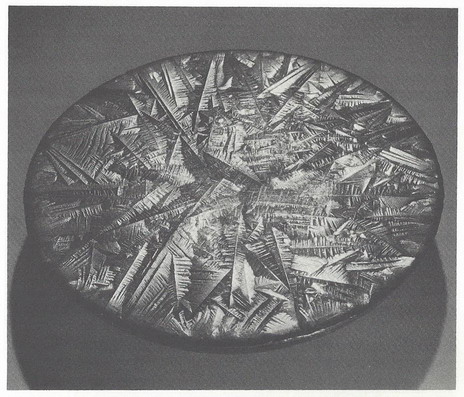
Figure 2. The "star regulus" of antimony, the crystalline form of metallic antimony, produced from antimony trisulfide (Sb2S3), a common ore of antimony metal known
also as crude antimony and stibnite. Philalethan alchemy requires that the ore be
reduced with the aid of iron. Slow cooling under a thick slag would lead to the
formation of the crystalline star. Courtesy of The Science Museum, London.
@
Figures 3A-G. Illustrations from the 1695 Opera omnia of Philalethes. All but the first of these illustrations are closely related to a manuscript found in the Vatican library
(Vaticanus latinus 7286). The Vatican MS. does not mention Philalethes, thus opening
the possibility that its illustrations derive from a different source, or, more likely, that it
has supplemented the images of Philalethan alchemy with others. At any rate, the
illuminations do represent the same processes as those underlying the works of
Philalethes. Therefore I will interpret them as an early modem reader of the Opera omnia
would do--as pictorial representations of the loci in Philalethes' works.
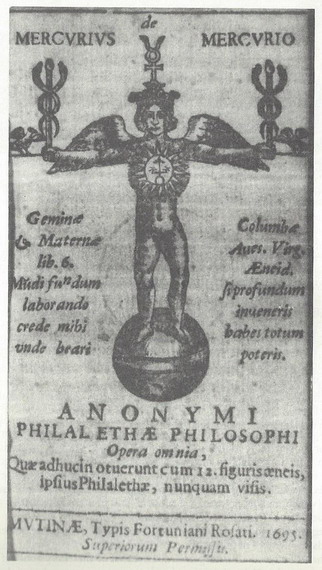
Figure 3A. The frontispiece: "The twin doves and maternal [i.e., Venerial] birds of Virgil, Book VI, Aeneid. If, by working, you find the profound basis of the world, believe
me, you have everything that can make you happy." These doves (to the left and right of
the winged figure) are the ones referred to in the Introitus apertus. No doubt the Aeneid
is the remote source, but Starkey got them more immediately from Stanza XLII of Jean
d'Espagnet's Arcanum Hermeticae Philosophiae; see Jean Jacques Manget, Bibliotheca
chemica curiosa (Geneva, 1702), 2:653. The Arcanum says that Jason could not have
acquired the golden fleece without the doves of Venus and the insignia of Diana, which
calmed the monsters guarding it. Jason's search for the golden fleece is a common
symbol for the alchemical quest, though the precise interpretation of Diana's doves as
silver seems peculiar to Philalethan alchemy.
The winged figure holding two caducei is the god Mercury. The phrase "mercury from mercury" over his head refers to the production of the sophic mercury, the first ingredient
of the philosophers' stone, from vulgar quicksilver. By standing on a globe, Mercury
acquires the shape of a cross surmounting a circle: this was the standard symbol for
crude antimony (antimony sulfide) in the seventeenth century. The emblematist thus
implies that the philosophical mercury is made from antimony as well as quicksilver.
Upon Mercury's chest is a sun containing a symbol that seems to combine the planetary signs of the seven metals--gold, silver, tin, copper, lead, iron, and mercury.
This symbol may have been inspired by the monas hieroglyphica of John Dee, pictured
sideways in Figure 3C (bottom). Since Mercury is wearing a crown, the combined
metallic symbol is probably meant to express the fact that the sophic mercury "rules"
over all the metals, potentially containing them and having the power to convert all of
them to gold.
@
@
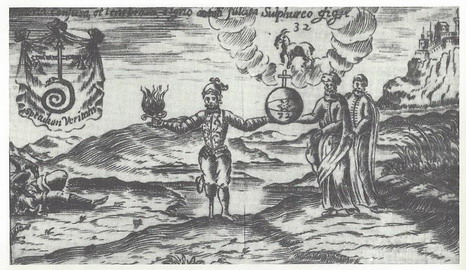
Figure 3B (top). Materia confusa, et tenebrosa, signo aetati [MS: astrali] fulcita Sulphureo (Confused and shadowy matter, sustained by the sulfurous astral sign).
The various elements of this emblem imply that the production of the sophic mercury must begin with the reduction of metallic antimony from stibnite by means of iron. The
coiled snake surmounted by a cross once again represents crude antimony (or stibnite,
Sb2S3). Beneath it is written "Mirror of Truth." The triangles at each end of the cross
could refer to the "three fires" or menstrua in the alchemy of the pseudonymous
Artephius. In Philalethan alchemy these are taken to be quicksilver, antimony, and iron,
the "trinity" of ingredients making up the sophic mercury. The three fires receive a
description on page (59) of Philalethes' Exposition upon Sir George Ripley's Preface and
elsewhere in his corpus.
Beneath the coiled snake one can make out two dogs, one of them picking at a reclining figure. This might be a reference to Chapter VII of the Introitus, where the rabid
Corascene dog bites a hermaphrodite who is then drowned by the doves of Diana, only
to resurface as a blackening dog. The hermaphrodite is the star regulus of antimony (the
crystalline form of metallic antimony), and the Corascene dog is probably, the hidden
sulfur of iron. The doves refer to the two parts of silver that must be added to one part
of regulus in order to produce the sophic mercury. The water in which the hermaphrodite
drowns is quicksilver, and the blackening dog is the amalgam of quicksilver and the
star regulus (which, at this point of the process, still contains impurities that must be
cast off as black dregs--hence the term blackening).
The one-legged man to the right is Vulcan, usually a symbol of fire or heat. In his left hand he holds the symbol of antimony, containing the star of the stellar regulus within.
In his right hand he bears a flaming sword, a symbol of the "fiery soul" of iron. Above
the antimony symbol in Vulcan's left hand is the goat Aries, a member of the astrological
fiery triplicity. Aries is also the astrological sign that makes up one of the two houses of
Mars, and this, along with the reference to Mars implied by the sword, supplies another
hint that iron must be used in the making of the sophic mercury. The two other male
figures seem to be generic wise men.
@
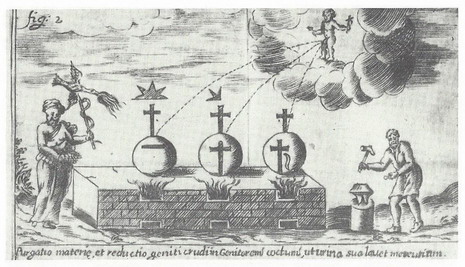
Figure 3B (bottom). Purgatio materiae et reductio geniti crudi in Genitorem coctum, ut urina sua lavet mercurium (Purgation of the matter and reduction of the crude offspring
into the cooked parent, so that it may wash the mercury with its urine).
The figure on the left holding a caduceus is intended to represent vulgar quicksilver, just as the blacksmith to the right is a symbol for iron. Between them is a furnace with
three antimony symbols acting as flasks. These symbols--showing, from right to left,
the cross within being decomposed and replaced with a growing star above--allude to
the "purgation" of the stibnite as it loses its sulfur and becomes the star regulus. The
urinating, cherub-like figure above is the "son of Saturn," a term used by Starkey in The
Marrow of Alchemy to symbolize crude antimony. Just as the son of Saturn is crude
antimony, "old Saturns pisse" is the star regulus (see book 1, part 2, stanzas 21-23 of The
Marrow). The caption's reference to washing with urine is an allusion to the blackness
given off when the star regulus is amalgamated with silver and quicksilver, seen here as
a "washing" of the quicksilver. In his 1651 letter to Robert Boyle, Starkey refers to the
"great stink" that is given off when the silver, quicksilver, and metallic antimony are
combined.
@
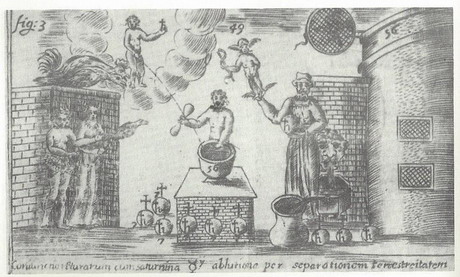
Figure 3C (top). Conjunctio naturarum cum saturnina
 ii ablutione per separationem
terrestreitatem [MS: tenebrarum] (Joining of the natures with the saturnine washing of
ii ablutione per separationem
terrestreitatem [MS: tenebrarum] (Joining of the natures with the saturnine washing of
mercury by removal of darkness).
Here the washing of mercury with "urine" is fully spelled out. This lavation is "saturnine" because it uses "Saturn's pisse," the star regulus, again represented by a
urinating child. A female figure, perhaps Diana, is seen at left, holding a bird; another
bird is pictured behind a grate attached to the furnace. Once again, these birds may
represent Diana's doves, alluding to the need for silver in the amalgamation process,
clearly described in Starkey's 1651 letter to Boyle. As Starkey specifies in the Introitus,
the amalgamation takes place with grinding in a mortar.
@
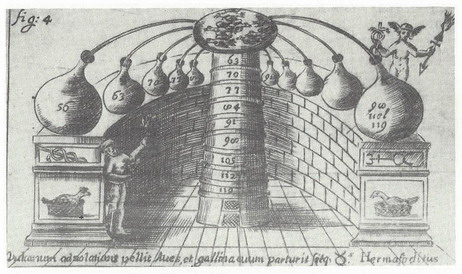
Figure 3C (bottom). Vulcanum [MS: Vulcanus] advolativas [MS: ad volatum] vellit Aves, et gallina ovum parturit sitque
s Hermaphroditus (Vulcan plucks the flying birds, and the
hen gives birth to the egg, and it should be the hermaphroditic mercury).
The globe surmounting the furnace is a distillation flask, which leads out to ten receivers, and the birds within may be eagles. Eagles recur throughout the Philalethan
corpus, as in the Introitus. Starkey's 1651 letter to Boyle explicitly says that these eagles
represent successive sublimations. In Chapter IX of the Introitus, it is said that the sophic
mercury for gold requires seven to ten eagles: in other words, the antimonial amalgam
must be sublimed seven to ten times before it acquires sufficient purity to unite with
gold and produce the philosophers' stone. It is likely that the ten receivers pictured here
are meant to imply the ten sublimations referred to by the Introitus.
The roosting chicken and goose could signify the "Bird of Hermes, now called a goose," of Chapter VII of the Introitus; once again this is the sophic mercury, as is the
hermaphrodite alluded to in the caption. The sophic mercury is hermaphroditic because
it combines the fiery sulfur of iron with the watery mercury potentially present in crude
antimony--a union of opposites. The emphasis on mercury is also underlined by the
presence of a winged Mercury, a recumbent caduceus, and a horizontal monas hieroglyphica;
cf. C. H. Josten, "A Translation of John Dee's Monas Hieroglyphica (Antwerp,
1564) with an Introduction and Annotations," Ambix 12 (1964), 84-221.
@
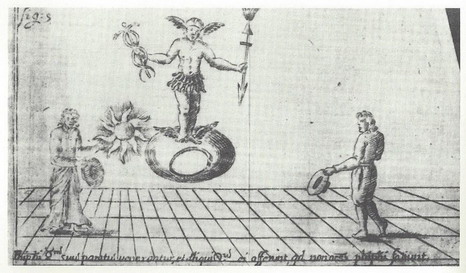
Figure 3D (top). Philosophi
um suum paratum venerantur et Aliqui solus [MS: Aurum]
ei offerunt, quod non omnes philosophi sapiunt [MS: faciunt] (The philosophers worship
their prepared mercury, and some offer the sun to it, which not all the philosophers have
sense enough to do).
The winged Hermes stands atop an ourobouros dragon, no doubt symbolizing the universal power of the sophic mercury. On the left a robed figure is offering it the sun,
clearly an allusion to gold. This emblem could be inspired by Chapters XV and XVI in
the Introitus, where Philalethes advises that the sophic mercury, once produced, must be
combined with gold. Starkey's 1651 lettes to Boyle explains that this was necessary in
order to supply the ferment that would allow the philosophical mercury to mature and
eventually become the philosophers' stone.
@
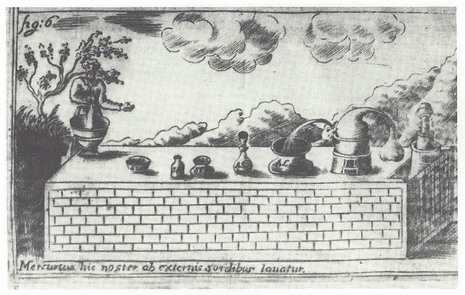
Figure 3D (bottom). Mercurius hic noster ab externis sordibus lavatur (This mercury of ours is washed from external filth).
Like the figure at the top, this emblem may be inspired mainly by Chapters XV and XVI of the Introitus. It refers to the fact that when the sophic mercury and gold are
joined, the resulting product must again be cleansed of its black impurities. A clear
recipe is given in the Introitus, advising that the amalgam must be boiled in a solution of
vinegar and sal ammoniac in a long-necked flask, ground in a hot mortar, and then
washed in water.
@
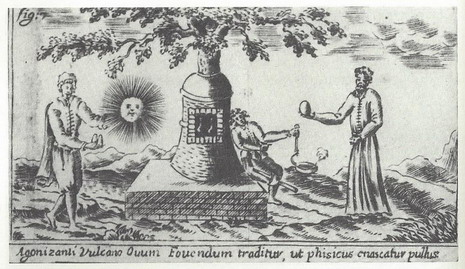
Figure 3E (top). Agonizanti Vulcano Ovum Fovendum traditur; ut phisicus enascatur pullus (The egg to be incubated is given to agonizing Vulcan, so that the natural chick
may be born).
Now that the sophic mercury has been prepared and joined to gold, the alchemist must seal it up in a flask or "philosophical egg" and heat it for a period of months. Then
the "chick," the nascent philosophers' stone, will be born. The curions furnace surmounted
by a tree is intended to represent the "hollow oak" as in the Introitus (Chapter
II). Starkey got this image from page 81 of Nicolas Flamel's Hieroglyphicall Figures
(London, 1624).
@
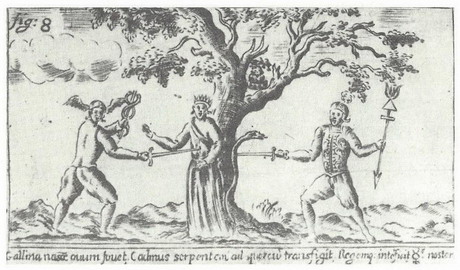
Figure 3E (bottom). Gallina nascoe [fortasse pro incubatione? MS: om.] ovum fovet, Cadmus serpentem ad quercum transfigit, Regemque interlicit
s noster (The hen incubates
the egg; Cadmus has fixed the snake to the oak, and our mercury kills the king).
This emblem again could be derived from Chapter II of the Introitus, along with Chapter IX, but this figure and the oves that follow suggest that if so, the emblematist
misunderstood his source. The Marrow of Alchemy (book 2, part 1, stanza 68) makes it
absolutely clear that Cadmus represents the iron used to reduce antimony sulfide: "Old
Saturns Son, let two parts taken be, Of Cadmus one, and those so long be sure By
Vulcans aid to putrefie, till (free from Faeces) the metalline parts be pure; This shall be
done in four reiterations, The Star shall teach you perfect operations." Despite this
clarity, the emblematist has made Cadmus' killing of the serpent synchronous with the
mercury's killing of the king, which is a reference to the dissolution of gold in the sophic
mercury and its subsequent putrefaction within the philosophical egg.
@
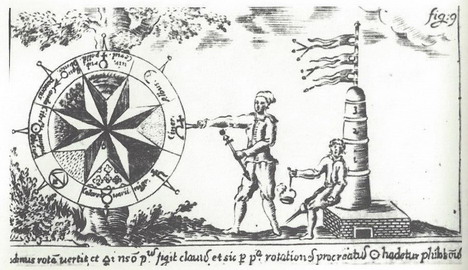
Figure 3F (top). Cadmus rotam vertu, et
i nostro primum figit clavum, et sic per prima
[MS: primam] rotationem procreatus  hadetur [MS: habetur] philosophorum (Cadmus
turns the wheel, and he fixes the first nail to our sulfur, and thus by means of the first
rotation, the generated sun of the philosophers is obtained).
The wheel or rota is taken from the alchemist George Ripley, as illustrated by the following passage from Philalethes' Breviasy of Alchemy; or, A Commentary upon Sir
George Ripley's Recapitulation (London, 1678), pp. 22-23: "But yet again Two times turn
about thy Wheel, &c. The Stone being by constant and long Decoction brought to this
pass; he who thinketh the race quite run, reckons without his Host, and must reckon
again; It is Medicine of the first Order, and must be brought to the third Order by
Imbibitions and Cibation, which is a second turning round the Wheel; and by Fermentation,
which is a third turning round the Wheel, and brings the Medicine to the third
Order, and makes it then fit for Projection ... our Sulphur then is a Royal Infant, which
doth both hunger and thirst." Cadmus is shown making the first turn.
Ripley's three wheels are themselves an elaboration of the "three orders" and "three medicines" of the thirteenth-century alchemist pseudo-Geber. According to that author,
the alchemical "medicines" could exist in three strengths: only the medicine of the third
order was capable of transmuting base metals into real gold, and was thus the genuine
philosophers' stone. Cf. William R. Newman, The Summa perfectionis of pseudo-Geber
(Leiden, 1991), pp. 162-167.
Within the wheel's perimeter are the symbols of the seven planets, followed by a barbed triangle within a circle. The planets bear the following captions: Mercury, various
colors; Saturn, black; Jupiter, cinereal; Luna, white; Venus, green, red, blue, pale [?];
Mars, dark yellow, peacock's tail; Sol, yellow, dark purple. These refer to the successive
regimens through which the sophic mercury, fertilized by gold, was supposed to pass on
its way to becoming the philosophers' stone. They are described in detail in the Introitus,
Chapters XIX--XXX.
@
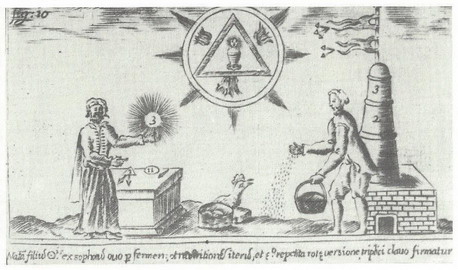
Figure 3F (bottom). Natam [leg: Natus MS: Natura] filius [ MS: filium]
is ex sophorum
ovo per fermentum, et nutritionem[?] iterum, et tertio[?] repetita rotae versione triplico clavo
firmatur (The son of the sun, born of the wisemen's egg by fermentation and feeding,
again on the repeated turning of the wheel should be strengthened the third time with a
triple nail).
Here Cadmus has turned the wheel again, evidently for the third time. The wheel has become a triangle within a circle, the alpha and omega containing the solar infant, who
is himself the philosophers' stone. The figure at left holding a sun containing the
number three may betray the origin of the emblem, as might the caption's reference to
"fermentation." lt could be taken from Chapter XXXI of the Introitus, called "Fermentatio
Lapidis," where Philalethes says that the stone, once prepared, should be strengthened
with three parts of "most purged sol," in other words, highly refined gold. The
figure at right feeding a chicken is an elaboration of the idea that the stone must be "fed."
@
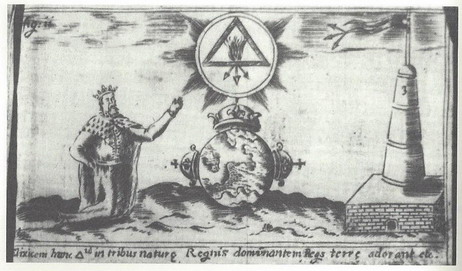
Figure 3G (top). Elixirem hunc
 is [MS: igneum] in tribus naturae Regnis dominantem
Reges terrae adorant etc. [MS: om. etc.] (The kings of the world adore this elixir of fire,
is [MS: igneum] in tribus naturae Regnis dominantem
Reges terrae adorant etc. [MS: om. etc.] (The kings of the world adore this elixir of fire,
ruling in the three realms of nature).
The elixir or philosophers' stone, once fully prepared, is the wonder of the world and the darling of adoring kings. Throughout the Philalethan corpus, the philosophers'
stone is said to be "fiery," a reference to its ability to penetrate to the depths of base
metals and purge them of their impurities.
@
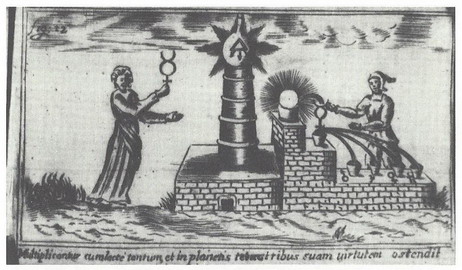
Figure 3G (bottom). Multiplicantur [MS: Multiplicatur] cum lacte tantum, et in planetis terrestribus suam virtutem ostendit (Let it be multiplied only with milk, and it will show
its power among the terrestrial planets).
Here the philosophers' stone sits in its flask atop the alchemical furnace. The robed figure at the left progressing toward the furnace is holding the symbol of mercury (fitting
the allusion to the stone being multiplied with its own "milk"). Chapter XXXIII of the
Introitus, called "Lapidis Multiplicatio," advises that the perfected stone should be
conjoined with one to four parts of the sophic mercury and run through the regimens
again. By doing this repeatedly, one can increase the power of the elixir thousands of
times. This idea is derived from the notion of three medicines, acquired from pseudoGeber,
as noted in the caption to Figure 3F (top).
The scene at the right shows the philosophers' stone being mixed with mercury, and the latter acting on iron, tin, copper, and lead. It may be inspired by Chapter XXXIV of
the Introitus, where Philalethes says that one part of the multiplied stone or "medicine"
should be mixed with ten of hot quicksilver to dilute it. Once this is done, the alchemist
will have a medicine of inferior order, which can then be projected upon any fused,
purged metal. The result, according to Philalethes, will be the transmutation of the base
metal into a gold or silver "so pure that nature will give no purer."
@
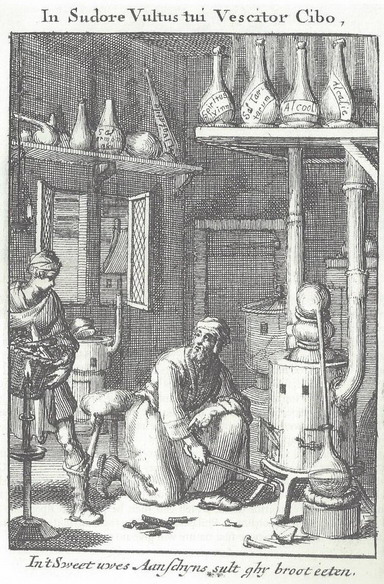
Figure 4. Portrait of an alchemist, evidently meant to be Starkey, at his furnace, with reagents pictured above him. Note the humble circumstances of this laboratory, and the
blunt biblical caption: "You must earn your bread by the sweat of your brow." This is
marked contrast to the fabulous aura surrounding the alchemy of Starkey's persona,
Eirenaeus Philalethes, as pictured in the Modena Opera omnia of 1695 and elsewhere.
From Pyrotechnia ofte Vuur-stooh-Kunde (Amsterdam, 1687).
@
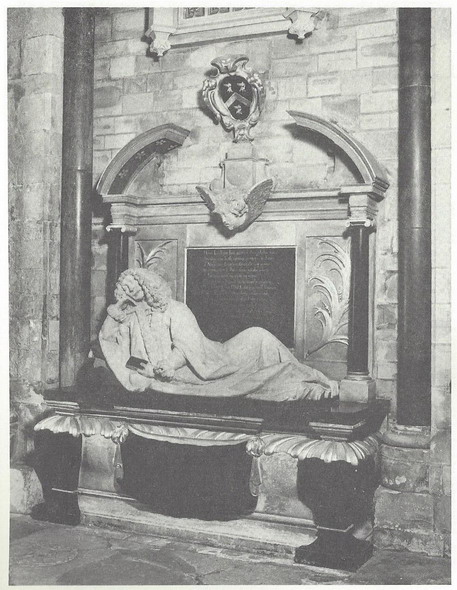
Figure 5. The tomb of the famous medical empiric Lionel Lockyer (d. 1672). Lockyer gave substantial sums to Saint Saviour's Church, now Southwark Cathedral, where this
effigy remains. Courtesy of the trustees of Southwark Cathedral and Jarrold Publishing.
@
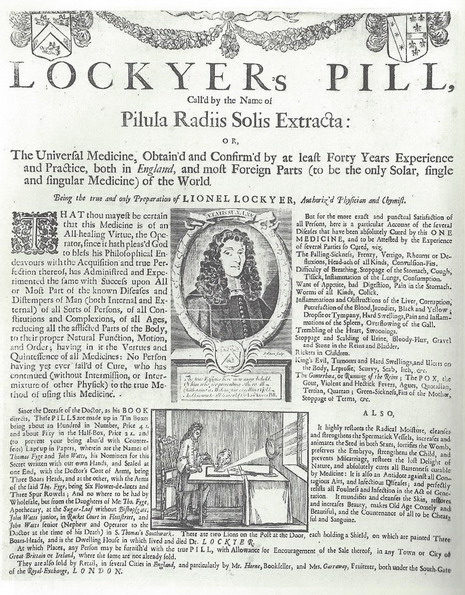
Figure 6. An undated medical broadsheet advertising Lionel Lockyer's Pilula Radiis Solis Extrada (Pill Extracted from the Rays of the Sun). The illustration shows a
"chymist," probably Lockyer, calcining an unspecified mineral by means of magnified
solar rays. Since such solar calcinations were sometimes viewed in the seventeenth
century as concentrating and "attracting" the rays of the sun, this may be the origin of
Lockyer's logo. Courtesy of the Wellcome Institute, London.
@
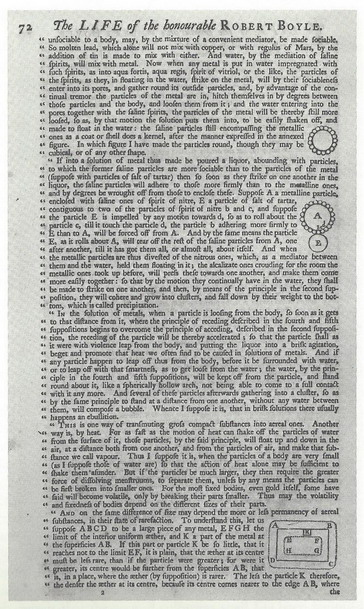
Figure 7. A page of Isaac Newton's letter to Robert Boyle of 1678/9. The figure of a sphere surrounded by smaller particles illustrates Newton's concept of saline particles
"encompassing the metallick ones as a coal or shell does a kernell." The same terminology
appears in the corpus of Eirenaeus Philalethes, with which Newton was intimately
acquainted. From the 1744 edition of The Works of Robert Boyle; by permission of the
Houghton Library, Harvard University.
@
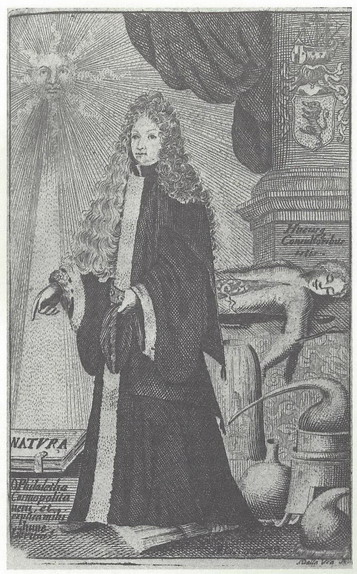
Figure 8. An anatomized corpse bearing the caption "Only so far with the other advisors" refers to the limits of traditional dissection. The iatrochemical followers of
Paracelsus von Hohenheim often referred to alchemy as a "dissection" or "anatomy" of
minerals, deliberately contrasting their method to that of the orthodox medical schools.
Thus the standing figure, evidently Nathan Lacy, points to the closed Book of Nature
while imploring, "Come, Philalethes Cosmopolita, and explain this book to me." From
Nathan Lacy, De podagra (Venice, 1692); by permission of the British library, London.
@
@
@
Signes de Chimie.
1 -
 Antimoine.
2 -
Antimoine.
2 -  Huile.
3 -
Huile.
3 -  Tartre.
4 -
Tartre.
4 -  Sel.
5 -
Sel.
5 -  Amalgame.
6 -
Amalgame.
6 -  Nitre.
7 -
Nitre.
7 -  Pierre.
8 -
Pierre.
8 -  Prenez.
9 -
Prenez.
9 -  Soufre.
10 -
Soufre.
10 -  Poudre.
11 -
Poudre.
11 -  Vinaigre.
12 -
Vinaigre.
12 -  Eau forte.
13 -
Eau forte.
13 -  Alambic.
14 -
Alambic.
14 -  Creuset.
15 -
Creuset.
15 -  Eau-de-vie.
16 -
Eau-de-vie.
16 -  Eau régale.
|
|
|
|
|
|
|
|
|
|
|
|
|
|